
Comply Partial Exemption Processing
The following changes will be available in Comply version 18, which is expected to be released at the end of October.
On May 24, 2018, the President signed the Economic Growth, Regulatory Relief, and Consumer Protection Act (the Act) into law. This resulted in a partial exemption of certain HMDA requirements for certain insured depository institutions and insured credit unions. The Consumer Financial Protection Bureau (CFPB) published its Interpretive Procedural Rule on August 30, 2018, outlining which Data Points are not required of institutions that meet the partial exemption requirements. This document is an overview of how Comply will address the partial exemption changes for any institution that meets the criteria and elects to follow the partial exemption for their HMDA submission.
Note: The current partial exemption rules for open-end lines of credit do not apply until January 1, 2020, as the thresholds for being fully exempt and partially exempt are the same. If your institution meets the threshold for the open-end partial exemption, the reporting of this data is not required until then. However, Comply will not restrict you from selecting this option; an informational warning will be given.
In reviewing the partial exemption changes, the ruling allows any institution that meets the requirements of the partial exemption to opt out of reporting 25 data points. However, the institution can also opt to report one or more of the exempt data points it chooses. The institution can also opt to report using a Non-Universal Loan Identifier (NULI) in lieu of the Universal Loan Identifier (ULI) on any partially exempt loan applications. In this instance, Comply will fall back to reporting the Application Number field as was done in prior years.
Note: Some data points are comprised of multiple fields.
Note: One data point, Open-End Line of Credit, will still be required so that Comply can determine which loan applications are closed-end versus open-end, and therefore subject to potential partial exemption.
Since institutions have already been collecting the partially exempt data points for two-thirds of the year, and masking the data with exempt codes will not be beneficial for reports and analysis, RATA has taken a unique approach. The institution will have the ability to indicate which partially exempt data points to optionally submit under the rule (if any) in the reporting entity properties. Comply will utilize the list of optional data points selected to determine which fields need to be automatically populated with the appropriate code (Exempt, NA or 1111) in the submission file.
We believe this approach provides for maximum flexibility by eliminating the need for data being imported to have the proper exemption codes in place and offers for full analysis by the institution of their HMDA data without the loss of important data points due to the masking of data. You can continue collecting the partially exempt data points, or at the very least retain what you have already collected, without affecting the submission file.
Reporting Entity Properties
If an institution would like to exercise its right to partial exemption, the Reporting Entity Properties Submission tab allows you to set options related to partial exemption of closed-end mortgage loans and open-end lines of credit.
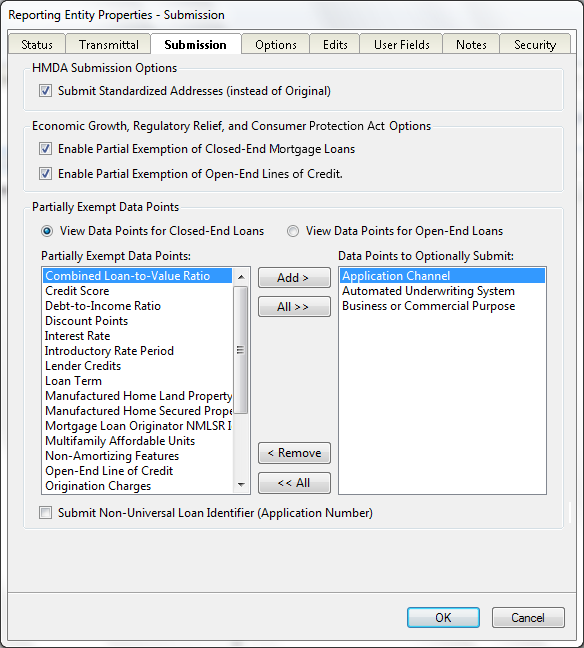
If the institution elects to utilize partial exemption rules, simply check the checkbox for the applicable partial exemption(s) then optionally select any non-required data points that you want to report. You can also choose to report the NULI (Application Number field) by checking the checkbox below the optional data point lists.
Note: Using the NULI will restrict your application number to 22 characters instead of the 23 characters permissible if the ULI is used.
Form Views
When viewing your data, you can opt to view all HMDA fields or use a minimal view that removes all data points that are exempt. You can also optionally create a view of your own that selectively shows any data points you have opted to include in your submission while leaving out any other data points that you are not submitting. When viewing all HMDA fields, any fields that are not enabled for optional submission are designated in the form view as falling under the partial exemption rule and therefore not being submitted with the remainder of your HMDA data.
Edit Checks
Any data points that are selected for optional submission despite the partial exemption will be fully edit checked using all CFPB/FFIEC validity and quality edit checks as well as any RATA validity and quality edit checks to ensure accurate and complete data is reported. The edits that are affected are automatically enabled/disabled based upon the selections made in the reporting entity properties on the submission tab.
Submission
During submission of your HMDA data you will be required to "sign off" on the partial exemption options chosen in the reporting entity properties. The following pages will appear in the Submission Wizard.
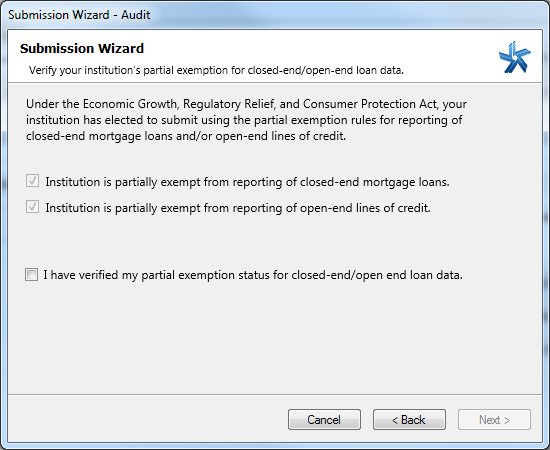
This screen will appear if you have opted to be partially exempt for either or both of the partial exemption options (Closed-End Mortgage Loans and Open-End Lines of Credit). The checkboxes at the top of the form will be checked in relation to which partial exemption(s) have been chosen. If the information is correct, check the checkbox that you have verified the exemption status to continue.
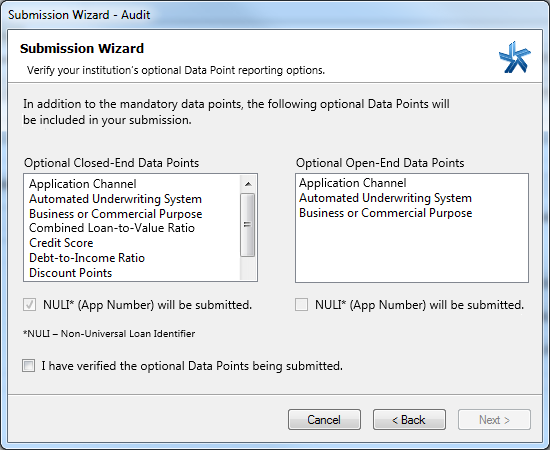
If you have opted for either or both partial exemptions, this screen will appear and show you which optional Data Points you have elected to submit in your submission file. Below the lists of optional Data Points to be submitted, you will also see a checkbox stating whether the NULI is being submitted for the appropriate closed-end and open-end loan data.
The submission file that is created at this point will contain all required fields and additional data as provided in the optional Data Point fields. Any fields that are not designated as optional Data Points to submit will automatically be populated with the proper exempt code (Exempt, NA or 1111) as required per the CFPB Filing Instructions Guide and as directed in the CFPB's Interpretive Procedural Rule.

- California's New Fair Lending Exam Law: What State-Chartered Banks, Credit Unions and Mortgage Licensees Should Have Ready
- How to Benchmark Your CRA and HMDA Lending Against Peer Data
- HMDA vs CRA vs Section 1071: What Each Rule Collects and Who Has to File
- Fair Lending Regression Analysis: What It Controls For and How to Explain a Pricing Disparity
- 2026 HMDA Data: Your Filing Checklist for the March 1, 2027 Deadline
- 2018 Edits Finally Released by CFPB
- 2018 HMDA Changes - What's the Word?
- RATA's Customer Care Campaign
- HMDA Plus: What It Actually Changed in the LAR Workflow
- How to Fix the 10 Most Common HMDA Edit Check Errors
- CFPB and DOJ Settle Redlining Claims Against Non-Depository Mortgage Companies Before Change in Administration
- How to Evaluate Fair Lending and CRA Software: What to Test Before You Sign
- What a Fair Lending Exam Actually Asks For
- Fair Servicing: What Examiners Test in Servicing Data, and How to Test It First
- What Actually Counts as a Small Business Loan Under Section 1071
- Section 1071 in 2026: What Lenders Need to Know About Small Business Lending Data

