


Discover Comply SBL (1071) Today!
Request a Comply SBL (1071) Demo Now
or call (407) 831-7282 — Mon–Fri, 8:00–5:00 Eastern
What happens next: a compliance specialist replies the same business day to book a time. The demonstration runs 30 to 45 minutes, screen-shared, with nothing to install and no commitment.
- Trusted since 1987
- 39+ years
- FFIEC compliant
RATA Associates helps financial institutions comply with the CFPB's Section 1071 small business lending data collection rule. RATA Associates does not offer SBA loans, and Section 1071 is a CFPB reporting requirement, not an SBA loan program.
Be Section 1071 Ready Before the Deadline
RATA Associates has built compliance software since 1987, applying that 39-year track record to Section 1071 the same way it does to HMDA and CRA: automated data collection and CFPB-aligned edit checks rather than a spreadsheet built in-house.
If you are covered, 1071 needs a census tract for the borrower address exactly as HMDA does, which is why the same Compliance-grade geocoding sits behind it — 98%+ accuracy on tract assignment, and a published method for how that is measured.
What you'll see in your demo: a compliance specialist runs Comply SBL (1071) on a sample file and takes it through the Section 1071 cycle, starting with the import of small business applications and ending with a submission file in CFPB format. Leave time for your questions about the 2026 rule.
Your demonstration covers:
- Whether you are covered at all: your covered originations to small businesses counted against the 1,000-transaction test, using the Section 1071 coverage checker.
- Import from your origination system: the Import Wizard reads fixed-length and delimited files, with field mapping and custom conversions so the data meets CFPB requirements on the way in.
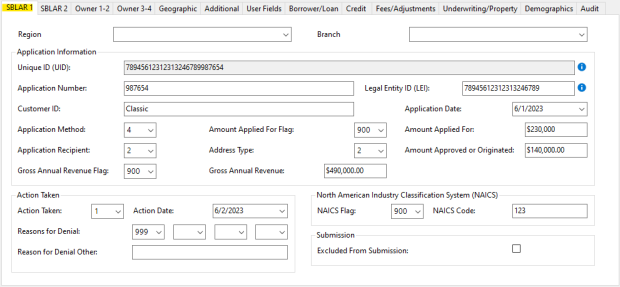
- The SBLAR tabs: the application, the business profile and credit product, and demographics for up to four principal owners, each on the tab where a reviewer would look for it.
- CFPB validity and quality edits: errors that must be fixed before submission, quality flags you can mark verified, and edit updates that arrive as the CFPB refines the specification.
- Census tract geocoding: batch the whole file or geocode one application, with re-geocoding when an address changes.
- The submission file: the Submission Wizard confirms the data is edit-free and fully geocoded, then writes the file in exact CFPB format.
- One database with HMDA and CRA: the same Data Manager and reports your team already uses for HMDA and CRA filing.
Which lenders does Section 1071 cover under the 2026 rule?
Under the CFPB's reconsideration final rule, published May 1, 2026, a lender is covered by Section 1071 if it originated at least 1,000 covered credit transactions for small businesses in each of the two preceding calendar years. Farm Credit System lenders are excluded. A small business is now one with $1 million or less in gross annual revenue for its preceding fiscal year, down from $5 million. Lenders that clear 1,000 in both 2026 and 2027 must comply starting January 1, 2028, and a lender that first crosses the threshold later complies no earlier than January 1, 2029. The rule replaced the old tiered schedule with that single date. Run your two years through the coverage checker, or read what counts as a small business loan under the current rule.
What data does a Section 1071 record hold now?
A Section 1071 record describes the application, the business and its owners. It carries the credit type, purpose, amount applied for and amount originated, the action taken, the census tract of the business, its gross annual revenue, NAICS code and time in business, whether it is minority-owned or women-owned, and the ethnicity, race and sex of its principal owners, which the lender must ask the applicant for directly. The 2026 rule removed the discretionary fields for application method, application recipient, denial reasons, pricing and number of workers. Comply SBL lays the record out across its SBLAR tabs, with room for up to four principal owners per business.
How does Comply SBL catch errors before a 1071 submission?
Comply SBL runs every CFPB validity and quality edit for Section 1071, and its edits update automatically as the CFPB refines the filing specification. A validity failure has to be fixed before the file can go. A quality edit flags a value worth a second look, and one that is correct can be marked verified, which keeps review shorter in later cycles. Census tract geocoding is built in and re-runs when a borrower address changes. Once the data is ready, the Submission Wizard checks that every record is edit-free and fully geocoded and generates the file for upload to the CFPB.
Last updated: October 13, 2026
Ready to see Comply SBL (1071)?
A specialist walks you through it on RATA sample data, thirty to forty-five minutes, whenever suits you. Nothing to prepare.
Schedule Demo or call (407) 831-7282
What our clients say
RATA Associates is one of the greatest companies I've known. It's been a pleasure adding my 2 cents to RATA Comply improvements (Fair Lending with Advanced Analysis/Regression option) that benefit everyone and help many companies in the mortgage industry to stay compliant.
Leo Batura
Pacific Union Financial LLC

RATA provides the tools and resources to assist with lending pattern analysis for fair lending and CRA to maintain appropriate monitoring and reporting. The staff at RATA are helpful and will provide assistance quickly when needed.
Margaret Dolinger
TCA

Would highly recommend both the product and the personnel!! Being able to accomplish what I did in such a short period of time is a testimonial to the product's user friendliness as well as the support I received from the great folks at RATA. Could not have done it without them!!!
Judy A. Edwards
Greer State Bank

