
The Regulation B Lawsuits: What Your Fair Lending Program Should Keep Doing While the Rule Is in Court

Two lawsuits now ask federal judges to throw out the CFPB's April 2026 amendments to Regulation B, the rule that implements the Equal Credit Opportunity Act. The amendments drop the "effects test" for disparate impact, narrow what counts as discouraging an applicant, and restrict how for-profit lenders can run special purpose credit programs. They took effect on July 21, 2026, and no court has paused them. This article covers what the rule changed, who sued and what they want, which fair lending obligations the case does not touch, and which monitoring a fair lending program should keep running while it waits.
Everything below is read from the final rule, the complaints and the coverage linked in each paragraph. None of it is legal advice, and we make no guess about how either case will come out.
What did the CFPB change in Regulation B?
The CFPB published the final rule, "Equal Credit Opportunity Act (Regulation B)," on April 22, 2026, at 91 FR 21620 (docket CFPB-2025-0039). The rule says it "amends provisions related to disparate impact, discouragement of applicants or prospective applicants, and special purpose credit programs." The Bureau finalized it as proposed in November 2025, and it took effect 90 days after publication. Reading the rule text, four changes stand out:
- Disparate impact. Section 1002.6(a) now reads: "The Act does not provide that the 'effects test' applies for determining whether there is discrimination in violation of the Act." The revised commentary leaves one exception, for facially neutral criteria that "function as proxies for protected characteristics designed or applied with the intention of advantaging or disadvantaging individuals based on protected characteristics."
- Discouragement. Section 1002.4(b) now covers only an "oral or written statement" that the creditor "knows or should know would cause a reasonable person to believe" it would deny credit, or grant it on worse terms, because of a prohibited basis. The commentary adds that "encouraging statements directed at one group of consumers cannot discourage other consumers who were not the intended recipients."
- Special purpose credit programs. A for-profit program "shall not use the race, color, national origin, or sex" of the applicant as a common characteristic for eligibility (new 1002.8(b)(3)). Other prohibited bases need evidence, for each participant, that they would not get the credit without the program.
- Self-testing. Section 1002.15(d)(1)(ii) drops its reference to prospective applicants, to match the wording of the statute.
The rule gives no separate compliance date. The Bureau wrote that "not much time, if any, would be needed for creditors to comply" with the disparate impact and discouragement changes. SPCP credit extended before July 21 stays under the program rules in place when it was made. The rule also says the amendments apply prospectively and "will not affect statements or actions that have already occurred, or cases that have already been decided."
The two lawsuits: who filed, where, and what they ask for
National Fair Housing Alliance v. CFPB (D.D.C.)
The first suit was filed on May 27, 2026, in the U.S. District Court for the District of Columbia, by the National Fair Housing Alliance, Rise Economy, BLDS, LLC and SolasAI. The case is National Fair Housing Alliance et al. v. Consumer Financial Protection Bureau et al., No. 1:26-cv-01820, before Senior Judge Beryl A. Howell (Ballard Spahr, Consumer Finance Monitor). The plaintiffs argue the CFPB exceeded its authority under ECOA and violated the Administrative Procedure Act. American Banker quoted the complaint: "The final rule does not reflect reasoned decision-making." The plaintiffs also challenge whether Russell Vought was lawfully serving as acting director when the rule issued (Troutman Pepper Locke).
They asked for declaratory and injunctive relief and vacatur, but Ballard Spahr reports they "did not seek preliminary injunctive relief," so the rule took effect on schedule. An amended complaint filed in August names Acting Director Mark Paoletta and adds a claim that the CFPB failed to consult the prudential regulators (National Law Review).
National Urban League v. CFPB (D. Mass.)
The second suit was filed on October 29, 2026, in the District of Massachusetts by the National Urban League and the Massachusetts Association of Community Development Corporations (MACDC), against the CFPB and Mark Paoletta as acting director. It is Case 1:26-cv-14891. Counsel are the National Consumer Law Center and the NAACP Legal Defense and Educational Fund (complaint; LDF press release).
The complaint has six counts. It calls the rule arbitrary and capricious, says the cost-benefit analysis was flawed, and says the CFPB skipped required procedure, including the Regulatory Flexibility Act and consultation with the prudential regulators. It argues the rule was issued without lawful authority because Vought was serving as acting director in violation of the Constitution and the Federal Vacancies Reform Act. The last two counts target the discouragement changes, saying they are contrary to ECOA and that the CFPB "lacks authority to create these types of safe harbors or otherwise alter evidentiary rules." The prayer for relief asks the court to declare the rule unlawful, "vacate the Final Rule," and "find the Final Rule void and with no effect."
What does not change while the case runs?
Unless a court sets it aside, the amended Regulation B is in force. But the rule only governs how the CFPB reads ECOA, and several other sources of fair lending risk sit outside it.
- ECOA itself. The statute's text is unchanged. What changed is the regulation's statement on whether the statute supports an effects test, and that is the exact question both suits put to the courts.
- The Fair Housing Act and state law. The CFPB says in the rule that lenders "are still subject to other antidiscrimination statutes such as the FHA and State laws similar to ECOA," and that it "has primary authority for administering ECOA, but not other Federal or State laws that include a disparate-impact component." HUD has proposed removing its own Fair Housing Act disparate impact regulations, leaving the question "to the courts" (HUD supplemental proposal, August 2026). It has not finalized that change.
- Disparate treatment and redlining. The federal banking agencies stepped back from disparate impact before the CFPB did. The OCC said in July 2025 that its fair lending supervision "no longer includes examining for disparate impact liability," and the NCUA said in September 2025 its exams "will no longer include reviews for disparate impact." The FDIC revised its exam manual to focus on disparate treatment (Troutman Pepper Locke). The OCC said its exams still include "analyzing Home Mortgage Disclosure Act data for possible evidence of disparate treatment." Intentional discrimination, including redlining, stays illegal under ECOA and the Fair Housing Act whatever happens to the effects test.
- State exams. California's AB 801 tells the state's Department of Financial Protection and Innovation to examine state banks, credit unions and mortgage licensees for compliance with federal and California anti-discrimination law, and to correct any "discriminatory effect" under California's Fair Employment and Housing Act "that is not attributable to a legitimate business interest." It takes effect January 1, 2027. Our explainer on California's new fair lending exam law covers who is in scope.
There is also a timing point. Both suits ask the court to vacate the rule, and the Regulation B text it replaced included the effects test. A program that stopped measuring outcomes in July would have a gap in its records if that text came back.
The monitoring to keep running
Most of the analysis a fair lending program runs answers more than one legal question. A pricing gap that survives your credit factors is a disparate impact question under the old Regulation B. It can also be the first sign of disparate treatment, and it is an exam question under California's FEHA. So the work that matters now looks much like the work that mattered last year.
- Pricing and underwriting disparity checks on HMDA data. Compare denial rates, rate spreads and fees across groups, then test whether the gap holds once the factors your policy actually uses are held constant. Fair lending regression analysis: what it controls for explains the model and how to document an explanation.
- Redlining review. Count applications and originations in low- and moderate-income tracts and in majority-minority tracts, and hold them against peer lenders and market size in the same areas. Look at branch and marketing coverage too. Redlining is intent-based, so the rule change does not take it off the table.
- Exceptions and overrides. Discretionary pricing and underwriting exceptions are where disparate treatment usually shows up. Review who received them.
- A documented self-assessment. Our fair lending self-assessment guide walks through the steps. Under 12 CFR 1002.15(c), the self-test privilege applies only if the institution takes "appropriate corrective action" when a test shows a likely violation, so plan the follow-up before you run it.
The cheapest choice may also be the safest. Keep running the same tests on the same schedule and keep the outputs. That way the history is there whichever way the courts go.
What to watch next in the litigation
In the D.C. case, the parties agreed to decide it on cross-motions for summary judgment. Ballard Spahr reported a schedule with the plaintiffs' motion due September 29, 2026, the CFPB's opposition and cross-motion due November 10, 2026, the plaintiffs' reply due December 22, 2026, and the CFPB's final reply due January 12, 2027. Courts can move those dates. No decision is expected before the briefing closes.
In Massachusetts, the complaint was filed on October 29. As of November 3, we found no reporting of a motion for preliminary relief or a CFPB response. Three things are worth following in both cases: any motion asking a court to stay the rule, the ruling on the acting-director challenge (which goes to whether the rule was validly issued at all), and whether a court that rules against the CFPB vacates the whole rule or only parts of it.
How Comply Fair Lending, Peer-2-Peer and Mapping support this monitoring
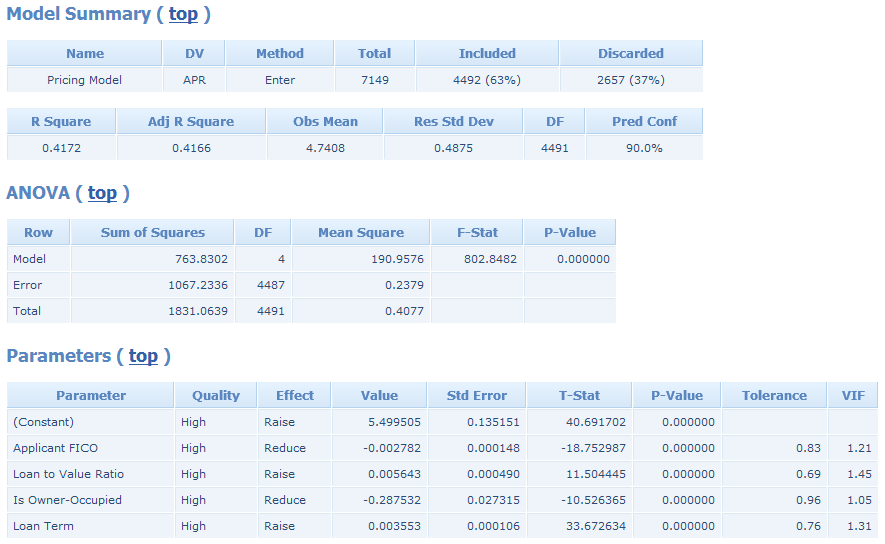
Comply Fair Lending runs the pricing and underwriting regressions on your own loan data and shows which factors went into each model, how they were coded, and which applications drive the result. The model summary below is the output an examiner reads.
Comply Peer-2-Peer compares your lending with peer groups built from the aggregate HMDA and CRA data examiners use, and Comply Mapping plots applications, branches and tract demographics against your assessment areas. Together with Fair Lending and DataMine, they run the redlining review, which is an analysis on those modules rather than a separate product. If you would rather not run the software on your own servers, RATA Hosted Services hosts every Comply module for you. For background on the rules themselves, see our fair lending overview.
Sources
- Equal Credit Opportunity Act (Regulation B), final rule
CFPB, 91 FR 21620, April 22, 2026, effective July 21, 2026. Text read from the public inspection copy, November 3, 2026. - National Urban League and MACDC v. CFPB, complaint
U.S. District Court for the District of Massachusetts, Case 1:26-cv-14891, filed October 29, 2026. - Lawsuit Challenging CFPB's Revised ECOA Rule Moves Forward Under Lengthy Summary Judgment Schedule
Ballard Spahr, Consumer Finance Monitor, August 10, 2026. - CFPB sued over new rule that would weaken fair lending laws
American Banker. - NFHA amends challenge to CFPB's Regulation B rule
National Law Review. - OCC Bulletin 2025-16, July 14, 2025, and NCUA press release, September 2025.
- HUD, supplemental proposed rule on Fair Housing Act disparate impact, August 2026.
Photo by Katrin Bolovtsova on Pexels.



- The Regulation B Lawsuits: What Your Fair Lending Program Should Keep Doing While the Rule Is in Court
- How to Benchmark Your CRA and HMDA Lending Against Peer Data
- 2026 HMDA Data: Your Filing Checklist for the March 1, 2027 Deadline
- How to Evaluate Fair Lending and CRA Software: What to Test Before You Sign
- HMDA Plus: What It Actually Changed in the LAR Workflow
- November 2026
- October 2026
- September 2026
- August 2026
- March 2026
- February 2026
- January 2026
- 2025
- 2022
- 2021
- 2020
- 2017
- How to Fix the 10 Most Common HMDA Edit Check Errors
- CFPB and DOJ Settle Redlining Claims Against Non-Depository Mortgage Companies Before Change in Administration
- CFPB, DOJ Order Trident Mortgage Company to Pay More Than $22 Million for Deliberate Discrimination Against Minority Families
- What a Fair Lending Exam Actually Asks For
- Fair Servicing: What Examiners Test in Servicing Data, and How to Test It First
- Fair Lending Self-Assessment: A Step-by-Step Guide for 2026
- What Actually Counts as a Small Business Loan Under Section 1071
- Section 1071 in 2026: What Lenders Need to Know About Small Business Lending Data

