
2027 HMDA Filing Instructions Guide: What Changed From 2026 and What to Update Before January 1

On November 18, 2026, the CFPB published three things for next year's HMDA data, announced on the FFIEC HMDA news and updates page: the 2027 Filing Instructions Guide (FIG), the 2027 Supplemental Guide for Quarterly Filers, and the HMDA Beta Platform for data collected in 2027. We read the 2027 guide against the 2026 guide line by line. The data fields and valid values are the same. What moved is the edit set: one edit comes back, one is new, one is removed, and about a dozen quality edits get new thresholds or logic. Below is every change we found, what stayed put, and what to check in your LAR and loan origination mapping before applications start counting toward 2027 on January 1.
Key takeaways
- The CFPB released the 2027 FIG, the 2027 quarterly guide and the 2027 Beta Platform on November 18, 2026.
- The 2027 FIG covers HMDA data collected in 2027, which you file in 2028. Your 2026 data, due March 1, 2027, still follows the 2026 FIG.
- No data fields or valid values changed. The changes are in the edits, and the biggest is S303: an LEI that does not match the institution you are filing for becomes an error you must fix, not a quality flag you can confirm.
- Check your NMLSR ID capture first. Edit V695 now rejects IDs that start with zero or consist only of 1111, 7777, 8888 or 9999.
- Read the change list yourself in section 2 and Table 3 of the 2027 FIG.
Mapping work for 2027 due now? Schedule your free demo today.
What changed in the 2027 HMDA Filing Instructions Guide?
Only the edits changed in any way that affects a filer. The guide says, as it did last year, that "there are no significant changes to the submission process for data collected in 2027 and reported in 2028." Its version log (dated November 2026, version 1.0) lists nine items. Two are housekeeping: the calendar year moved forward and the Application Date and Action Taken Date examples were updated. One is a wording fix to the Income instruction. The other six are edit changes, collected in the guide's Table 3, "2027 Edits Revised From 2026."
The table below puts the 2026 and 2027 versions of each substantive edit side by side. Every cell comes from the edit tables in the 2026 FIG and the 2027 FIG.
| Edit | Data point | 2026 FIG | 2027 FIG |
|---|---|---|---|
| S303 (syntactical) | Legal Entity Identifier | Not in the guide. An LEI mismatch was checked by quality edit Q303. | Reinstated. The LEI must match the institution you are filing for, and the file cannot be submitted until it does. |
| Q303 (quality) | Federal Agency; Tax ID | Federal Agency, Tax ID and LEI must match the filing institution. | Checks Federal Agency and Tax ID only. LEI moved to S303. |
| V695 (validity) | NMLSR ID | Four to seven digits, not above 3000000. | Four to seven digits or NA, not above 3000000. Must begin with a non-zero digit. Cannot be only 1111, 7777, 8888 or 9999. |
| Q607 (quality) | Loan Amount | Subordinate-lien loan amount should be $250,000 or less. | Removed. |
| Q614 (quality) | Age | Applicant and co-applicant age should be 18 to 100. | 18 to 105. |
| Q615 / Q616 (quality) | Origination Charges; Discount Points | Total Loan Costs (or Points and Fees) should be greater than the charge. | Greater than or equal to the charge. |
| Q617 (quality) | Combined Loan-to-Value | For conventional loans, CLTV should be greater than or equal to LTV. | LTV should not exceed CLTV by more than 2 percentage points. |
| Q624 (quality) | Loan Amount, FHA, 1 unit | $637,000 or less. | $1,239,125 or less. |
| Q625 (quality) | Loan Amount, VA, 1 to 4 units | $1,050,000 or less. | $1,239,125 or less. |
| Q626 (quality) | Loan Amount, sold to Fannie Mae, Ginnie Mae, Freddie Mac or Farmer Mac, 1 to 4 units | $1,225,000 or less. | $1,239,125 or less. |
| Q627 (quality) | Loan Amount, 5 or more units | $100,000 to $10,000,000. | $100,000 to $50,000,000. |
| Q628 (quality) | Loan Amount, home purchase | More than $10,000 when Total Units is 4 or fewer. | More than $10,000 for a first lien, more than $1,000 for a subordinate lien. |
| Q645 (quality) | Loan Amount | Two conditions: at least $500, and at least $1,000 for a home purchase. | Only the $500 condition. Q645-2 removed because it overlapped Q628. |
| Q629 (quality) | Income | Income should not be NA on 1 to 4 unit home purchase, home improvement and other-purpose applications (Loan Purpose 1, 2 or 4). | Same, but only when Business or Commercial Purpose is 2 (not for a business purpose). |
| Q660 (quality) | Street Address | Flags ";", "&" or "and" as a sign of more than one address. | Also flags a backslash ("\"). |
| Q661 (quality) | Loan Amount, 1 to 4 units | Did not exist. | New. Loan amount should be less than $50 million. |
A second group of edits got new wording but kept the same test. V625, V626, V627, V716 and Q603 now point filers to the FFIEC Geocoding System for county and tract codes. V609 explains that the check digit is the last two digits of the ULI and points filers to a check digit tool (our ULI check digit calculator does the same job). V671 folds its two conditions into one, which is why V671-2 disappears. Q650 restates its two interest rate conditions as a single 0.5% to 20% range. V710, V711, V713, Q634 and Q646 were reworded for consistency, and Q646 now says plainly that it does not decide whether you qualify for a partial exemption. If your vendor or your own scripts key off condition numbers such as V671-2, Q645-2 or Q650-2, those numbers no longer exist.
What stayed the same from 2026
Most of the guide. Apart from the year, we found no difference in:
- The transmittal sheet and LAR data fields and their valid values (Tables 1 and 2).
- The file format: pipe-delimited .txt, no leading zeros used as padding, no scientific notation. The scientific notation rule was the 2026 addition.
- The submission process, which the guide itself says has no significant changes.
- The Income field. The 2027 text says "in thousands of dollars" where 2026 said "in dollars, rounded to the nearest thousand," but the examples in both guides already enter $200,000 as 200. This is a clarification. If your LOS export still sends whole dollars, though, now is a good time to catch it.
The quarterly guide changed only its dates. For 2027, the on-time deadlines are May 31 for the first quarter, August 30 for the second and November 29 for the third (2027 Supplemental Guide for Quarterly Filers).
What to check in your LAR and loan origination mapping before January 1
Applications with final action in 2027 will be edited under the 2027 guide, so the time to fix capture problems is before those records exist. In the order we would work them:
- Keep the two guides apart. The file you submit between January 1 and March 1, 2027 holds 2026 data and runs the 2026 edits. Do not retune that file to the 2027 thresholds. Set up 2027 rules as a separate edit set for the new year's records.
- Audit how the NMLSR ID is stored. V695 now fails an ID with a leading zero and an ID that is only a placeholder such as 9999 or 1111. Look at where your LOS defaults that field when the loan officer ID is missing, and make sure the export writes NA, or Exempt where you qualify, instead of a filler value.
- Confirm the LEI on the transmittal sheet. Under the 2026 guide an LEI mismatch surfaced as quality edit Q303 and could be confirmed. Under S303 the file stops. This matters most for affiliates or holding company structures where one team files for more than one LEI.
- Check that Business or Commercial Purpose is populated. Q629 now reads it. A record with that field blank or miscoded will be judged against the wrong rule.
- Reset your internal review queues. If your team routinely confirmed Q624, Q625 or Q626 on high-balance FHA, VA or agency loans, many of those flags will not fire in 2027. Q661 is new, so expect it to appear in reports and in any vendor edit list.
- Run a test file through the Beta Platform. The November 18 release describes the 2027 Beta Platform as "for testing purposes only" and says the CFPB will keep adding functionality, so treat a clean beta run as a good sign rather than a guarantee.
Want to see these checks run on your own LAR? Schedule a Comply HMDA/CRA demo.
What it means for HMDA, Community Reinvestment Act (CRA) and fair lending teams
Our read: the 2027 guide mostly cuts noise. The FHA, VA and agency loan limits in Q624 to Q626 now share one ceiling of $1,239,125, the multifamily ceiling in Q627 goes from $10 million to $50 million, and Q607 and Q645-2 are gone. Each of those used to produce flags on loans that were reported correctly, and each confirmed flag needs someone to look at the loan and write down why it is right. Fewer of those means more review time for the records that are actually wrong.
The guide also gets stricter in two places, and both were errors that used to slip through. An LEI mismatch can no longer be confirmed and filed. A placeholder NMLSR ID can no longer pass validation. Neither change costs anything for an institution whose data was already clean.
For fair lending work, the Q629 change is the one to notice. Income left NA on a business-purpose loan will no longer raise a flag, so more records may reach the filed LAR with no income at all. If your fair lending review compares applicants by income or uses it in a model, decide now how those records are handled, rather than finding out when a regression drops them without telling anyone. On the CRA side, the geography edits only gained a pointer to the FFIEC Geocoding System. The tract and county rules themselves did not change.
Running the edits in Comply HMDA/CRA
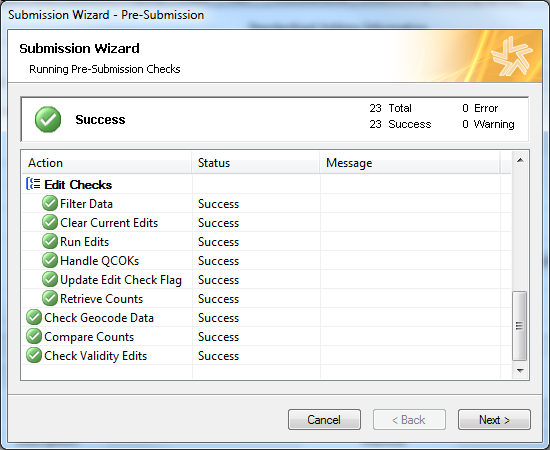
In Comply HMDA/CRA, validity, quality and macro edits run as you work, and each failed edit names the field and the rule. Before the submission file is written, the Submission Sentry runs the edits again along with geocode and record count checks. LAR records come in through the Import Wizard from any origination system, so the edits run on the records exactly as your LOS exported them.
Our free tools follow the guide for the data you are filing now. The HMDA edit check lookup and the HMDA edit check validator use the 2026 FIG, which is the right set for the 2026 LAR due March 1, 2027. For 2027 records, use the 2027 FIG and the comparison table above.
Related HMDA filing dates
- March 1, 2027 (Monday): 2026 HMDA data due, filed under the 2026 FIG. Our filing checklist for the March 1, 2027 deadline walks through the preparation steps.
- May 31, August 30 and November 29, 2027: quarterly deadlines for 2027 data, for institutions that reported at least 60,000 covered loans and applications, excluding purchased loans, in the preceding year.
- January 1 to March 1, 2028: the annual filing period for 2027 data, per the FFIEC's data collection timelines. March 1, 2028 is a Wednesday. Resubmissions of 2027 data stay open through December 31, 2030.
If 2027 is the year you want edit checks, geocoding and the submission file in one place, book a Comply HMDA/CRA demo or contact us.
Photo by RDNE Stock project on Pexels




- 2027 HMDA Filing Instructions Guide: What Changed From 2026 and What to Update Before January 1
- What Is an MSA? Metropolitan Statistical Areas, Census Tracts and Your Community Reinvestment Act (CRA) Assessment Area
- How to Choose Section 1071 Software: What to Test Before Your First Filing
- California's New Fair Lending Exam Law: What State-Chartered Banks, Credit Unions and Mortgage Licensees Should Have Ready
- How to Benchmark Your CRA and HMDA Lending Against Peer Data
- November 2026
- October 2026
- September 2026
- August 2026
- March 2026
- February 2026
- January 2026
- 2025
- 2022
- 2021
- 2020
- 2017
- HMDA vs CRA vs Section 1071: What Each Rule Collects and Who Has to File
- 2026 HMDA Data: Your Filing Checklist for the March 1, 2027 Deadline
- HMDA Plus: What It Actually Changed in the LAR Workflow
- Fair Lending Regression Analysis: What It Controls For and How to Explain a Pricing Disparity
- How to Evaluate Fair Lending and CRA Software: What to Test Before You Sign
- What a Fair Lending Exam Actually Asks For
- What Actually Counts as a Small Business Loan Under Section 1071
- Section 1071 in 2026: What Lenders Need to Know About Small Business Lending Data

